


This past week has been a weird one for me and a lot of other longtime gamers and PC enthusiasts. Not often is the biggest news story in the world about a guy you know. Jensen Huang famously founded Nvidia from nothing with a small team of folks, and I covered the firm as a reviewer and member of the press almost from the start.
As a gamer, I bought myself a Riva 128 to play Quake. Then, in the early days of the web, I believe one of the first graphics cards I wrote about was the Riva TNT—before the name GeForce was even invented or prompted people to say, “Wait, is it GHEE-force? What’s the deal with the extra E?”
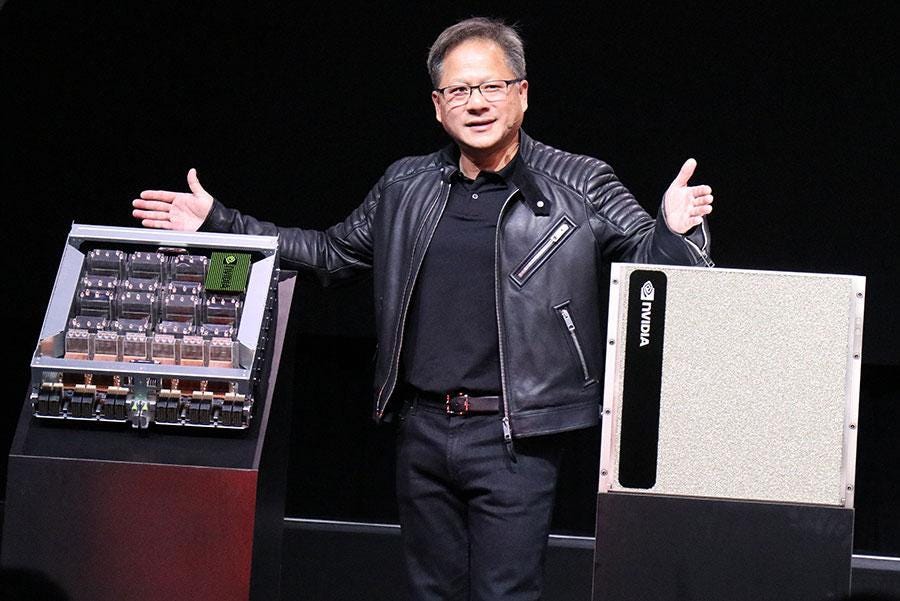
Now that Jensen has been ousted from Nvidia for, uh, doing too much parallel processing, I’d like to take a moment to reflect on his tenure there. It must be one of the greatest runs by a tech founder and CEO in history—arguably the greatest ever, ahead of folks like Bill Gates and Steve Jobs, given the huge upswing in the company’s valuation over the last several years.
Duck!
I’ll start by saying that it’s not surprising to me, or probably to anyone who knew him very long, that Jensen’s downfall ultimately involved his inability to control his passions. It is a little surprising that it happened in this way—with the sex scandals—and not sooner, over something else.
Jensen’s temper is legendary.
Perhaps you have heard the story about Jensen, in a fit of rage, chucking a stapler at an employee’s head. HR got involved, and the guy eventually left Nvidia.
During his presentation at Siggraph in 2018, a demo went wrong or something, and Jensen seemingly lost his place in the script. Nvidia exec Tom Petersen tried to step in and offer some words to help get things back on track. Jensen took exception to this intervention, and during the ensuing several minutes of interactions, he struggled—and partially failed—to contain his apparently incandescent rage at Tom in front of the world. It was incredibly awkward to watch.
Well before that, back in 2002, I got a small taste of the Jensen experience as a tech writer.
Ahead of the launch of its NV30 chip, Nvidia briefed me and others in the press to hype up its first DirectX 9-capable graphics processor. DX9 was a big deal because GPUs were gaining the ability to process floating-point math. In combination with multipass rendering, a graphics chip with floating-point datatypes would, in theory, be able to render just about any image or effect possible—including some utterly compelling photorealistic lighting scenarios in real time.
Unfortunately, the NV30 was hit with a series of setbacks. The chip was delayed, and rival firm ATI introduced its Radeon 9700 graphics processor—with full DX9 rendering capabilities and outstanding performance—first. Pictures of the NV30 cards leaked, revealing an unusual sight for the time: a massive, multi-slot cooler attached to the GPU.
To me, this big cooler was a clear signal that Nvidia couldn’t get the performance it needed to compete against the Radeon 9700 without some extra help. I wrote an article explaining to my readers that the tea leaves were not good when Nvidia had to strap a Dustbuster to its chip.
The response from Nvidia PR was swift: I was informed I would not be getting a review unit of the GeForce FX 5800 Ultra due to my, uh, crimes. I was cut off from review samples until further notice.
For the record, my prediction was spot-on. Nvidia did not fare well in that generation of the GPU wars. The NV30 was built with too many integer math pipelines and too few floating-point ones, leading to deficits in both image quality and performance. I bought a card on eBay and reviewed it anyhow, complete with decibel meter readings quantifying how ridiculously loud that Dustbuster was.
Eventually, I was brought back into the fold in time to cover the launch of the GeForce 6 series chips, which were vastly improved over the prior generation. My review obligingly told the story of Nvidia as the comeback kid, again quantifying the scope of the improvement with data.
This time, I received a rather different message in response from Nvidia PR, informing me that I had a fan in the company—a very well-placed one.
That was kind of how it went when covering Nvidia. I told the truth in both cases. The difference in the company’s reactions depended on whether that truth was happy news for Nvidia. The firm was consistently the most difficult one I covered because it was aggressive to a fault—and that was Jensen’s personality writ large.
Fortunately, my relationship with Nvidia improved over time, largely because the company didn’t make the same mistake twice. Specifically, as it told us at the GeForce 6 press day, the lesson it learned from NV30 was to characterize its target workloads and design GPU architectures that handle those workloads well. The company invested in the tools and the processes to get that right, and it virtually always delivered in the succeeding generations of GPUs.
That, too, was a product of Jensen’s leadership.
The future is fusion?
Another turning point in Nvidia’s history came a couple of generations later, at the launch of the GeForce 8800-series chips in late 2006.
AMD had acquired Nvidia’s direct rival, ATI, earlier that year and was talking about a future where CPUs and GPUs would work together. Meanwhile, Intel, the world’s largest chip manufacturer, was widely understood to be working on a discrete graphics chip code-named Larrabee.
Faced with two competing chip companies who could provide all of the major components of a PC platform, the conventional wisdom was that Nvidia was in trouble. Nvidia had no CPU business and no clear path to licensing the x86 CPU instruction set, which meant it was essentially locked out of offering a Windows-compatible processor.
During a Q&A at the GeForce 8 press day, I asked Jensen in front of the assembled press how Nvidia planned to compete in this difficult new landscape.
I will never forget his answer: “If we don’t add value with GeForce, we’re dead.”
That same day, in addition to the G80 chip, Nvidia announced a new way of programming its chips for general-purpose computing, something it called CUDA.
It did, in fact, add value—and the rest is history.
On adding value
Nvidia made a lot of good decisions on the road to larger success, and it avoided a lot of the mistakes its competitors made, in large part because of the presence of a charismatic founder and CEO who investors trusted to do the right thing. (Not necessarily with a stapler but with key business decisions.)
The right thing often involved choosing a direction, investing in it, and staying the course with an eye on the long-term future.
I think it’s fair to say that the typical leadership at a publicly held company does not do that. I have seen it up close, both as a journalist and as a worker bee.
Jensen understood that GPUs are a hardware-and-software product—not just a chip—and invested consistently in building the software and ecosystem around GPU computing.
After launching CUDA, Nvidia sent its CTO, David Kirk, into academia to write a textbook and establish curricula for teaching CUDA programming to college students. Soon, it started up its Nvision conference, which eventually gave way GTC, a forum where academics and industry types discuss how to exploit GPU computing in various domains—including, eventually, in machine learning.
Across town, Intel canceled its own developer forum in 2017. AMD intermittently talked a good game about data-parallel programming—anyone remember HSA?—but fundamentally remained a CPU company with a graphics chip business riding in a sidecar. With a funny helmet.
Over time, software became the lever that moved Nvidia GPUs from commodities that were interchangeable with competing graphics chips to heavily differentiated products. To say the least.
What happens now?
Nvidia is a great company with excellent technology and people, and it will still be great for at least a while without Jensen. There are always questions, though, about how well successful firms can maintain the cultures established by their founders. I have no idea what the future holds for Nvidia on that front.
We’ve all heard how Jensen famously ran a “flat” organization with something like 60 direct reports and his sweeping eye of Sauron observing all corners of his domain. I suspect Nvidia will have to adopt a more conventional corporate structure in his absence simply because there’s no viable alternative leader who can function like he did.
Who knows how well that will work?
Meanwhile, one wonders whether key figures up and down the org chart will have the stomach for confronting whatever comes next.
Nvidia has created so much wealth for so many people that you could probably step quite a few levels down the org chart and seniority rankings before finding someone who, you know, still has to keep working every day. Anecdotally, I know of two early retirements in recent months among my contacts there. If things do not go well with the new regime, the potential for brain drain at Nvidia is enormous, especially among those folks who best understand and embody the firm’s distinctive culture.
Whatever else happens, Nvidia will be diminished without Jensen. This is a sad ending to an epic run, and a great many of us—press, partners, consumers, competitors, and bystanders of various sorts—are better off because of what he accomplished. I hope folks can appreciate that fact.